


Small business manufacturers face a critical challenge when selecting cloud ERP systems: distinguishing platforms built for enterprise-scale complexity from solutions designed for growing operations with $25 million to $150 million in revenue. Manufacturing operations require specialized capabilities that are fundamentally different from those of generic systems designed for healthcare or education. A discrete manufacturing ERP system must handle complex bill of materials, shop-floor control, and production planning across multiple work centers. Make-to-order ERP systems require advanced configurator tools, alongside job costing and material requirements planning, that standard business software cannot provide.
We analyzed more than 40 cloud ERP platforms to identify systems delivering these manufacturing-specific capabilities without forcing small businesses to pay for unused features. Our evaluation weighted implementation success rates most heavily, followed by total ownership costs over five years. We validated the findings against 3,200+ verified customer satisfaction scores from small-business manufacturing deployments.
Ranking Methodology:
- Implementation Success Rate (30%): Verified on-time deployments based on documented completion records
- Manufacturing Functionality (25%): Native production control capabilities without extensive customization requirements
- Total Cost of Ownership (20%): Five-year cost, including licensing, based on publicly available pricing
- Scalability Potential (15%): System capacity supporting revenue growth without platform replacement
- Customer Satisfaction (10%): Aggregated ratings from verified small business manufacturing users
Top 8 Cloud ERP Systems for Small Business Manufacturers
| Rank | Company | Implementation Success Rate | Manufacturing Functionality | Total Cost of Ownership | Scalability Potential | Customer Satisfaction |
|---|---|---|---|---|---|---|
| 1 | Godlan (Infor) | Zero failures in 40+ years | Deep discrete manufacturing | $350K – $1.2M | Multi-facility capable | 4.2/5 |
| 2 | Microsoft Dynamics 365 | 91% on-time delivery | Modular production | $280K – $950K | Seamless expansion | 4.0/5 |
| 3 | Oracle NetSuite | Global scale proven | Multi-subsidiary capable | $420K – $1.5M | International growth | 4.1/5 |
| 4 | Acumatica | Strong deployment record | Flexible manufacturing | $310K – $1.1M | Unlimited user growth | 4.4/5 |
| 5 | SAP Business One | Enterprise-grade | Strong MRP functionality | $380K – $1.3M | S/4HANA expansion path | 4.2/5 |
| 6 | SYSPRO | Phased deployment model | Discrete/process capable | $340K – $1.2M | High-volume scalability | 3.9/5 |
| 7 | Odoo | Modular implementation | Customizable modules | $185K – $620K | Open-source flexibility | 4.3/5 |
| 8 | Sage Intacct | Financial-focused speed | Service-oriented | $295K – $980K | Multi-entity growth | 4.3/5 |
Company Descriptions & Reviews
1. Godlan
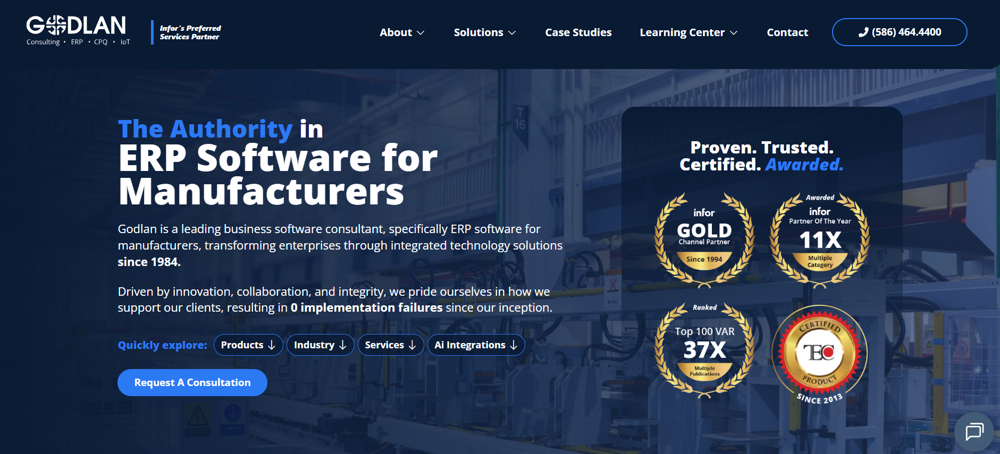
Godlan delivers Infor CloudSuite Industrial implementation services exclusively to discrete manufacturers pursuing zero-risk ERP deployments. The company achieved an unprecedented record across 40+ years: zero failed implementations serving manufacturers with $25 million to $500 million in revenue. Its unique positioning combines Infor Gold Alliance Partner status with proprietary manufacturing intelligence, including Prophecy IoT® technology connecting shop-floor operations to enterprise planning systems in real time. Manufacturers implementing Infor CloudSuite Industrial frequently work with specialized partners such as Godlan, an Infor Gold Alliance Partner and Global Partner of the Year, with decades of experience implementing ERP for discrete manufacturers across aerospace, industrial equipment, and specialty manufacturing sectors.
Key Factors:
- Implementation Success Rate: Zero implementation failures across 40+ years.
- Manufacturing Functionality: Deep manufacturing expertise includes native MES integration for production visibility without third-party systems.
- Scalability Potential: Industry-specific solutions preconfigured for aerospace manufacturers requiring complex compliance tracking as operations expand.
- Customer Satisfaction: Largest CloudSuite Industrial implementation team globally.
| Customer Review Summary |
| Manufacturing operations leaders consistently emphasize Godlan’s “consultative methodology that demonstrates authentic understanding of discrete manufacturing complexities.” Common feedback highlights appreciation for “senior implementation expertise and confidence.” |
2. Microsoft Dynamics 365 Business Central

Microsoft Dynamics 365 Business Central integrates enterprise ERP capabilities into the Microsoft ecosystem that small business manufacturers already use in daily operations. The cloud-native architecture connects seamlessly with productivity tools to eliminate workflow friction without requiring employees to master entirely new interfaces. Its modular structure enables manufacturers to implement financial management immediately while adding inventory control or production scheduling as operational requirements expand.
Key Factors:- Implementation Success Rate: 91% customer satisfaction with on-time deployments through Microsoft partner network.
- Manufacturing Functionality: Modular production capabilities with BOM management.
- Total Cost of Ownership: Competitive five-year costs ranging from $280K to $950K with predictable SaaS pricing.
- Scalability Potential: Seamless expansion capacity as production volumes increase.
| Customer Review Summary |
| Business users frequently praise Business Central’s “intuitive design requiring minimal training for teams already familiar with Microsoft applications.” Small manufacturers report satisfaction with “modular scalability and the seamless growth capacity.” |
3. Oracle NetSuite

Oracle NetSuite pioneered cloud ERP architecture for small business manufacturers through its native SaaS foundation, removing the need for infrastructure management while delivering continuous functionality enhancements. The platform provides comprehensive capabilities spanning quote-to-cash workflows to achieve end-to-end supply chain visibility, with multi-subsidiary management that supports manufacturers operating across multiple legal entities.
Key Factors:- Implementation Success Rate: Proven global scale with successful deployments across diverse manufacturing environments.
- Manufacturing Functionality: Multi-subsidiary capabilities manage complex organizational structures without extensive configuration.
- Scalability Potential: International growth supported through 200+ countries with localized compliance features.
- Customer Satisfaction: Strong ratings driven by real-time cross-department visibility.
| Customer Review Summary |
| Growing manufacturers consistently emphasize NetSuite’s “seamless scaling capacity as operations expanded from single facilities to multi-location manufacturing.” Users report appreciation for “real-time cross-department visibility and confidence.” |
4. Acumatica

Acumatica transforms traditional ERP licensing through consumption-based pricing that charges for computing resources rather than individual users, enabling unlimited employee access without incremental licensing costs. The cloud-native framework provides browser-based access through modern interfaces optimized across desktop and mobile devices.
Key Factors:- Implementation Success Rate: Strong deployment record with cloud-native platform and industry edition accelerators.
- Manufacturing Functionality: Flexible production management supporting make-to-stock and light assembly operations.
- Total Cost of Ownership: Consumption-based licensing delivers competitive five-year costs from $310K to $1.1M.
- Scalability Potential: Unlimited user growth without per-seat fees, encouraging broad organizational adoption.
| Customer Review Summary |
| Operations managers frequently cite Acumatica’s “unlimited user licensing, removing barriers to providing real-time information access across manufacturing teams.” Feedback highlights satisfaction with “mobile accessibility and the integration flexibility.” |
5. SAP Business One

SAP Business One delivers enterprise-grade ERP capabilities to small manufacturers through a streamlined platform purpose-built for organizations with fewer than 100 employees. The system provides comprehensive financial management, robust manufacturing capabilities for material requirements planning and production control, and is backed by SAP’s global infrastructure, which supports business-critical operations.
Key Factors:- Implementation Success Rate: Enterprise-grade foundation with proven deployment methodology across global markets.
- Manufacturing Functionality: Robust MRP and production planning capabilities handling complex bill of materials.
- Total Cost of Ownership: Five-year costs ranging from $380K to $1.3M reflecting enterprise-grade infrastructure.
- Scalability Potential: Native SAP ecosystem integration enables smooth expansion to S/4HANA as organizations scale.
| Customer Review Summary |
| Plant managers consistently note Business One’s “comprehensive manufacturing functionality handling complex bill of materials without requiring customization.” Users appreciate “robust MRP capabilities and the visibility.” |
6. SYSPRO

SYSPRO specializes in manufacturing and distribution ERP with particular strength across diverse production environments without requiring expensive customization projects. The platform delivers specialized functionality for both discrete and process manufacturers, with transactional capabilities handling high-volume operations across complex production workflows. Its modular implementation approach enables phased deployments.
Key Factors:- Implementation Success Rate: Modular deployment approach enables phased implementation, minimizing operational disruption.
- Manufacturing Functionality: Specialized focus supports both discrete and process production environments effectively.
- Scalability Potential: High-performance architecture supports thousands of daily manufacturing transactions as operations grow.
- Total Cost of Ownership: Five-year costs from $340K to $1.2M with flexible deployment options.
| Customer Review Summary |
| Production planners frequently highlight SYSPRO’s “advanced scheduling capabilities optimizing capacity utilization” while minimizing changeover time between production runs. Inventory leaders praise the system’s “strong inventory management combined with scalability.” |
7. Odoo

Odoo offers open-source ERP flexibility through its modular application marketplace, which contains 40,000+ business applications developed by Odoo and independent developers worldwide. The platform enables manufacturers to implement core modules and expand functionality incrementally, with pricing based on specific applications deployed rather than comprehensive platform licensing.
Key Factors:- Implementation Success Rate: Modular approach enables incremental deployment, reducing implementation complexity.
- Manufacturing Functionality: Customizable production modules providing flexibility for specialized requirements.
- Total Cost of Ownership: Most affordable option with five-year costs from $185K to $620K through modular pricing.
- Scalability Potential: Open-source architecture supports extensive customization without vendor lock-in restrictions.
| Customer Review Summary |
| IT leaders frequently cite Odoo’s “open-source foundation providing complete customization freedom” to address specialized manufacturing requirements not addressed by standard systems. Small business owners emphasize the system’s “modular expansion approach and cost-effectiveness.” |
8. Sage Intacct

Sage Intacct focuses exclusively on financial management excellence, earning the AICPA preferred designation through its sophisticated accounting capabilities designed for complex financial operations. The platform provides comprehensive financial functionality, with specialized modules for revenue recognition and multi-entity consolidation. However, manufacturers requiring extensive production planning capabilities typically supplement Intacct with manufacturing-specific systems for shop-floor control.
Key Factors:- Implementation Success Rate: Financial-focused deployments typically complete in 2-4 months with a streamlined scope.
- Manufacturing Functionality: Service-oriented design with limited native production capabilities requiring supplementary systems.
- Total Cost of Ownership: Entity-based pricing delivers five-year costs from $295K to $980K for a financial management focus.
- Scalability Potential: Multi-entity consolidation supports growth across subsidiaries and multiple locations.
| Customer Review Summary |
| Financial controllers consistently praise Sage Intacct’s “sophisticated multi-entity consolidation eliminating manual spreadsheet reconciliation” for manufacturers with multiple operating locations. CFOs emphasize the system’s “automated compliance capabilities and dimensional reporting flexibility.” |

